AVITECH ENGINEERS Offers / About ESPRIT CAM / ESPRIT CAM Products High-Speed Machining
ProfitMilling ® delivers 75% reduction in cycle time and 500% increase in tool life
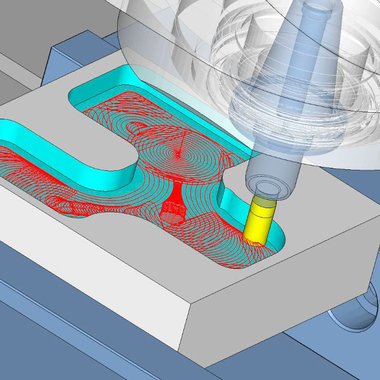
igh-speed machining with ESPRIT’s patented ProfitMilling cycles for 2.5-, 3-, 4-, and 5-axis roughing significantly reduces cycle times and dramatically increases tool life. The ProfitMilling strategy combines optimized, high-speed toolpath patterns, chip thinning with light radial engagements and full depths of cut, and dynamically optimized feed rates to maintain consistent chip loads and minimized cutting forces throughout the cut. This results in increased productivity and reduced operating costs.
ProfitMilling is a universal high-speed roughing cycle for 2- to 5-axis milling that requires no extra investments in specialized cutting tools, workholding, spindles, or machines. This cycle is designed to reduce loads on CNC machines, drives, and spindles, therefore it can even be used on light-duty machines. ProfitMilling is proven to work exceptionally well on most materials, with added value in Inconel, titanium, and others where the chip is hard to break. The combination of optimized toolpaths cutting at full depth with reduced radial engagement results in improved cutting performance and shorter cycle times. These techniques also transfer more heat to the chip instead of the tool and the workpiece, reducing the temperature at the cutting zone and extending tool life.
The ProfitMilling cycle’s dramatic improvements in cycle time and tool life are the result of a patented method of cycle optimization that produces consistent chip loads and reduced cutting forces. The optimized, high-speed toolpath patterns reduce the need for rapid machine accelerations and abrupt changes in direction which would otherwise negatively affect chip loads and increase cutting forces. A chip thinning technique cuts at full axial depth and reduced radial width, allowing significantly higher feed rates. To maintain the programmed chip load throughout the cut, the ProfitMilling cycle dynamically adapts the actual feed rate to account for the geometry and toolpath variances. Offset, spiraling, and trochoidal motions reduce the need for rapid machine acceleration or deceleration, increasing the overall velocity. Therefore, the programmed feed rate
is easier for the CNC to attain and overall material removal rates are maximized.
Cycle times are longer as machines must run at conservative cutting speeds to account for chipload and acceleration inconsistencies.
High-speed cycle allows for deeper cuts while increasing cutting speeds, resulting in shorter cycle times and longer tool life.